The average human SDR connects with 18 prospects per day. A voice AI agent connects with 1,800. But raw volume is not the advantage , the real edge is what happens when the AI picks up: a perfectly timed, perfectly scripted, perfectly delivered call. Every single time. This is the AI outbound calling playbook that top sales teams in 2026 are running.
Why AI Outbound Call Scripts Outperform Human Scripts
Human SDRs deviate from scripts under pressure AI outbound call scripts they skip discovery questions, rush the pitch, and fumble objections at exactly the wrong moment. The performance degradation is invisible in individual calls but catastrophic at scale. Voice AI delivers the script with 100% consistency across every call, every timezone, every language, whether it is call number one or call number nine thousand.
The performance gap compounds over thousands of calls. Teams running AI outbound call scripts see the performance gap compound with every thousand calls. AI also A/B tests script variations in real time, and the winning version gets deployed automatically across all agents.
The Anatomy of a High-Converting AI Outbound Call Script
Here is the exact structure that drives the highest outbound AI call conversion rates across industries:
Section 1: The Hook — First 8 Seconds
"Hi [Name], this is Aria from Vozzo AI , I'll keep this to 30 seconds. We've helped 3 companies in [their industry] cut their support costs by 40% using voice AI. Worth a quick conversation?"
The hook must state who you are, establish immediate credibility with a relevant result, and ask a low-commitment yes/no question. AI delivers this with perfect pacing and zero nervousness.
Section 2: The Discovery Bridge — 30 Seconds
"Before I tell you anything about what we do — can I ask, how are you currently handling your inbound call volume? And what percentage would you say is repetitive queries?"
Discovery before pitch is the single biggest conversion lever. AI asks these questions without rushing, actually listens to the answer, and routes the conversation based on the response in real time.
Section 3: The Tailored Value Statement — 20 Seconds
"Based on what you just said — [repeat their pain point] — what our clients typically see is [specific relevant outcome]. That's what I'd want to show you."
Personalisation at this stage dramatically increases conversion. Voice AI pulls CRM data mid-call to tailor this section to the prospect's industry and known pain points.
Section 4: The Soft CTA — 10 Seconds
"I'm not asking for a big commitment — just 20 minutes with our solutions team. Would [Day] or [Day] work better for you?"
The binary choice close (two dates, not an open question) is proven to increase booking rates by 30-40%. AI executes this flawlessly every call.
The 5 Most Common Objections and How Voice AI Handles Them
- "We already have an IVR system"
- "That's actually why most of our clients came to us — they had IVR but were seeing 40% abandonment rates. Voice AI is not an upgrade to IVR, it's a full replacement that actually resolves calls. Worth seeing the difference?"
- Reframe IVR as the problem, not the baseline — this objection is an opening, not a dead end.
- "We're not ready for AI yet"
- "I hear that a lot — usually it means the timeline question, not a no. Most of our deployments go live in under 3 weeks with zero changes to your existing phone system. Would it help to see a 10-minute demo first?"
- Reduce perceived complexity and commitment — "not ready" usually means "not sure it's easy enough."
- "Send me an email"
- "Happy to — and I will right after this call. But the email won't show you what the voice actually sounds like or how it handles your specific queries. Can I get 15 minutes on the calendar so you can hear it live?"
- The email deflection is the most common across voice AI cold calling campaigns. Redirect to a demo, not a brochure.
- "We don't have the budget right now"
- "Completely understand. What I'd ask is this — do you know what your current cost per call is? Because most of our clients find that voice AI pays for itself within the first 60 days purely from agent cost reduction."
- Reframe budget as ROI calculation — make them do the math in their head.
- "We tried AI before and it didn't work"
- "That's valuable context — can I ask what you tried? Because the gap between first-gen chatbots and today's voice AI is significant. What specifically didn't work? I want to make sure we're not the same conversation."
- Curiosity over defensiveness — dig into the past failure to differentiate, not dismiss.
Outbound AI Call Conversion Rates — What the Data Shows
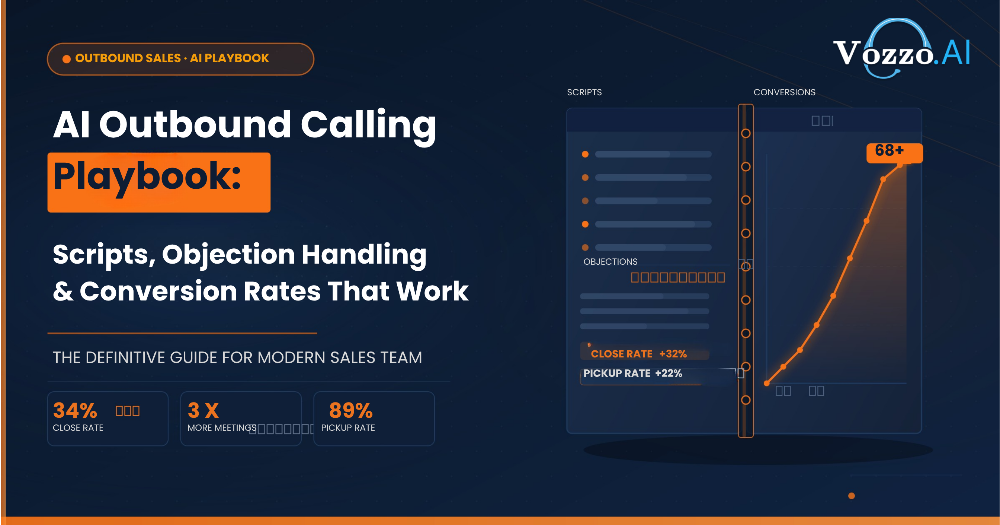
The outbound AI call conversion rate data from 2026 deployments tells a compelling story. Average connect rates with AI outbound sit at 22-28%, compared to just 8-12% for human cold calling teams. Meeting booking rates from connected calls reach 18-24% with optimised AI scripts. When it comes to cost efficiency, AI delivers qualified meetings at $12-$18 per meeting versus $85-$120 with a human SDR. Best performing industries include BFSI at 28% connect rate, real estate at 31%, and e-commerce at 24%. Perhaps most importantly for sales leaders evaluating speed to value: the median time to first qualified meeting after deployment is 48 hours.
3 Things That Kill AI Outbound Performance (And How to Fix Them)
- Scripts that sound like scripts
- If the AI sounds robotic or over-formal, conversion drops 40%. The fix: write scripts in conversational, spoken language — short sentences, contractions, pauses built in. Read it aloud before deploying.
- Calling the wrong list
- AI amplifies both good and bad targeting. A poorly segmented contact list will generate thousands of bad calls very efficiently. Invest in list quality first — firmographic filters, intent signals, recent trigger events.
- No human handoff protocol
- The highest-converting AI outbound flows hand warm prospects to a human within 4 minutes of the AI booking the meeting — a confirmation call, a Slack alert to the AE, a calendar invite with context notes. Without this, show rates drop by 30%.
How Vozzo AI Powers Outbound Calling at Scale
Vozzo AI's outbound voice agents handle prospecting, qualification, objection handling, and meeting booking — all integrated with your CRM so every interaction is logged, scored, and handed off automatically. Deployed across sales teams in BFSI, real estate, healthcare, and e-commerce with average connect rates of 25%+ and cost per meeting under $15. Every agent runs on the same optimised script, every time, at any volume your pipeline demands.
The AI outbound calling playbook is not a future state — it is what your best-performing competitors are running today. Scripts that never deviate. Objections handled consistently. Conversion rates that compound as the AI learns. If your outbound motion is still powered entirely by human SDRs making 80 calls a day, the gap is growing. See how Vozzo AI builds your outbound calling engine — book a demo at vozzo.ai