Manual KYC verification costs Indian banks ₹800–₹1,200 per customer. It takes 3–5 business days. It has a 12–18% error rate due to manual data entry. AI voice bots complete KYC verification in under 8 minutes, at ₹40–₹80 per customer, with 99.2% data accuracy. This shift is being driven by one technology in particular: the AI KYC voice bot, now being deployed across retail banking, lending, and insurance onboarding.
What Is an AI KYC Voice Bot and How Does It Work
An AI KYC voice bot is a conversational AI system that conducts the entire Know Your Customer verification process over a phone call or video-enabled call, without a human agent on the line for routine cases. It combines speech recognition, natural language understanding, optical character recognition for documents, and liveness detection into a single automated flow that a bank's compliance team configures once and reuses across every new customer.
Banks that deploy an AI KYC voice bot replace a process that previously required a trained verification officer, a scheduled appointment, and physical or video presence, with an on-demand call that a customer can complete from anywhere, at any hour the bank permits.
The Complete AI KYC Verification Workflow
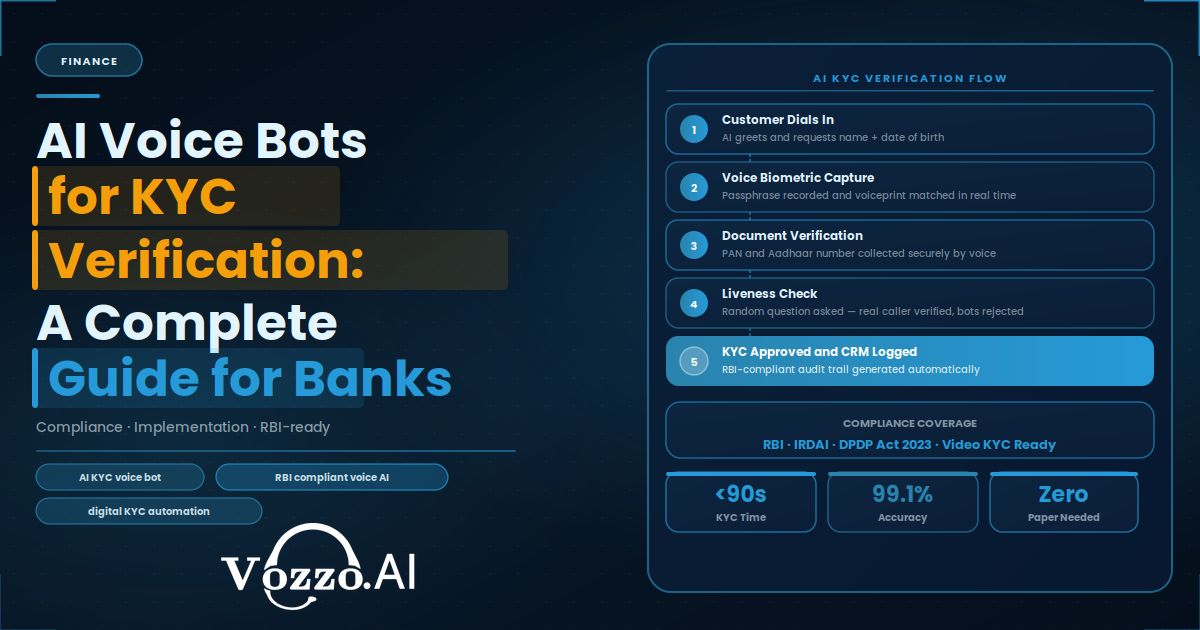
- Initiation: The customer requests KYC verification through the bank's app, website, or a scheduled callback, triggering an outbound or inbound AI voice call.
- Identity verification: The bot confirms the customer's name, date of birth, and government ID number, cross-checking against the application data already on file.
- Document confirmation: The customer is guided to present their Aadhaar, PAN, or other accepted ID on camera, while the system captures and validates the document image.
- Liveness check: The bot runs a randomized liveness test, such as asking the customer to blink, turn their head, or repeat a spoken code, to confirm a live person is present rather than a photo or recording.
- Data extraction and CRM update: Optical character recognition pulls the relevant fields from the document, cross-verifies them against the spoken responses, and writes the verified record directly into the bank's CRM or core banking system.
- Approval trigger: Once every check clears, the system automatically triggers account activation, loan disbursement, or policy issuance, with any borderline case flagged for human review.
RBI Compliant Voice AI What Compliance Actually Requires
RBI compliant voice AI is not an optional add-on, it is the baseline requirement for any bank considering automated KYC. The Reserve Bank's Video KYC guidelines, updated in 2023, specify the exact sequence of checks, including live document capture and geotagging of the customer's location, that any digital KYC process must follow. Separately, obligations under the Prevention of Money Laundering Act require banks to retain verification records and be able to reconstruct the exact sequence of a KYC call if requested by a regulator. The Digital Personal Data Protection Act adds a further layer, requiring that customer biometric and identity data captured during the call be stored on servers located in India, with strict access controls. Every AI KYC voice bot deployment must also maintain a complete audit trail of the call, the documents captured, and the decision logic applied, so that compliance teams can produce it on demand.
Digital KYC Automation vs Manual KYC , Cost and Accuracy Comparison
Digital KYC automation changes the underlying economics of onboarding in ways that are difficult to ignore. A manual KYC verification takes 3 to 5 business days from application to approval, whereas an automated voice-based process completes in under 8 minutes from start to finish. On cost, manual verification runs between ₹800 and ₹1,200 per customer once officer time, paperwork, and rework are included, compared to ₹40 to ₹80 per customer for the automated equivalent. Error rates tell a similar story: manual data entry introduces a 12% to 18% error rate across large onboarding volumes, while automated extraction and cross-verification bring that down to roughly 0.8%, a 99.2% accuracy rate. Scalability is the final differentiator, a manual team can only process as many verifications as it has trained officers on shift, while digital KYC automation handles peak onboarding periods, such as festive season account openings or loan campaign spikes, without adding headcount.
Which Banks and NBFCs Are Deploying AI KYC Voice Bots
Adoption is no longer limited to large private banks. New account opening is the most common use case, where a bank can complete the entire onboarding journey, from application to activation, without the customer visiting a branch. Loan disbursement KYC is another major deployment area, particularly for NBFCs processing high volumes of personal and consumer loans where verification speed directly affects disbursal turnaround. Insurance onboarding uses the same workflow to verify policyholders before issuing a policy, reducing the free-look cancellation rate tied to onboarding friction. DEMAT account activation, which historically involved lengthy paperwork and in-person verification, is increasingly handled through the same voice-based flow, letting brokerages activate trading accounts within minutes of application.
How Vozzo AI Powers KYC Voice Automation for BFSI
Vozzo AI provides RBI compliant KYC voice automation built specifically for banks, NBFCs, and insurers operating in India. The platform's document verification and liveness detection modules are designed around RBI's Video KYC framework, and its multilingual voice engine supports KYC calls in the customer's preferred regional language, extending reach into markets that traditional video KYC infrastructure struggles to serve.
See how Vozzo AI deploys RBI compliant KYC voice automation for your bank — book a demo at vozzo.ai