A BPO running 800 agents across three shifts employs a QA team of 12. Mathematically, that team can review roughly 1.5% of the calls generated in a single day. A mis-sold insurance policy slips through the other 98.5% of calls — and three weeks later, a regulatory notice lands on the compliance desk asking why nobody caught it.
What AI Call Intelligence Software Actually Does — And What It Does Not
Most call centers buy a transcription tool and call it call intelligence. The two are not the same thing, and the gap between them shows up the first time a regulator asks for evidence, not just a recording.
- It is not a transcription tool — transcription is the input, intelligence is the output. A transcript tells you what was said; intelligence tells you what it meant, whether it was compliant, and what to do next.
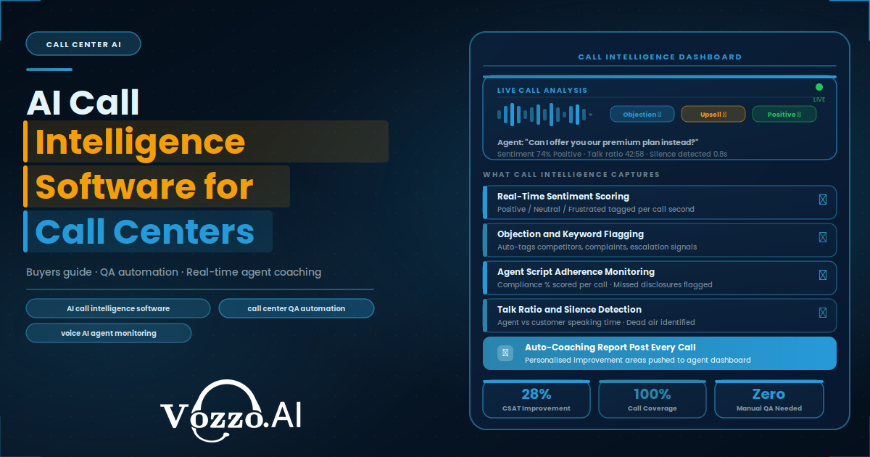
- It analyzes every call for agent compliance, customer sentiment, objection patterns, script adherence, and outcome prediction — in a single automated pass, not a manual checklist.
- It replaces the QA sampling model with 100% call coverage. Every agent, every call, every shift, reviewed the same way, with no bias toward the calls a supervisor happened to have time for.
- It surfaces patterns invisible to human reviewers — which objection kills conversion most often, which agent greeting drives the highest satisfaction score, which script deviation correlates with escalations.
- This is what call center conversation analytics is built to do at scale: turn thousands of unreviewed conversations into a searchable, scorable, audit-ready dataset instead of a pile of recordings nobody has time to listen to.
The 6 Capabilities That Define Genuine Call Intelligence vs Basic Analytics
Most "analytics" platforms stop at keyword spotting. The six capabilities below are what actually separate genuine call intelligence from a glorified transcript search bar.
- Real-time transcription with speaker diarization — agent and customer voices separated and identified accurately even on low-quality mobile calls. This is the foundation every other capability depends on; get it wrong and every downstream score becomes unreliable.
- Intent and outcome classification — the AI determines what the customer wanted and whether it was resolved, not just what words were spoken. This is the layer that turns a generic transcript into AI call intelligence software for call centers that operations teams can actually act on.
- Emotion and sentiment tracking — flags calls where customer stress escalated, agent tone became non-compliant, or the conversation went off-script. Sentiment data at this granularity turns a single bad call into an early warning instead of a surprise complaint weeks later.
- Automated QA scoring — every call scored against your own QA rubric automatically, not by a human listening and filling out a form. Scoring runs the same way on call one and call sixty thousand, which a manual QA process structurally cannot do.
- Compliance breach detection — surfaces calls where mandatory disclosures were skipped, prohibited language was used, or regulatory scripts were deviated from. These flags surface the same day the call happens, not three weeks later during an audit.
- Coaching recommendation engine — identifies the specific moment in a specific call where agent behavior cost the outcome, and flags it for team lead review. Coaching becomes a conversation about an exact 40-second clip instead of a vague scorecard number.
How BFSI Call Centers Are Using Call Intelligence Right Now
Collections call centers — AI flags every call where a promise to pay was made but not logged in the collections system. DPD bucket managers get a daily report of commitments versus follow-ups. Compliance teams get instant alerts the moment a collections agent uses language prohibited under the RBI Fair Practices Code.
Insurance sales call centers — AI verifies that every mandatory product disclosure was made before the sale was confirmed. Mis-selling risk gets reduced at the source instead of being caught in a post-sale audit. IRDA-aligned compliance scoring is built into every call review, not bolted on afterward.
BPO customer service operations — AI tracks first-call resolution rate at the individual agent level across 100% of calls. Team leads get weekly coaching packs showing each agent's top three improvement areas, with specific call timestamps to listen to. Nobody is coaching from memory or a gut feeling about who is struggling.
Before vs After AI Call Intelligence for a 500-Agent Call Center
Before: 12 QA analysts reviewing 600 calls per week out of 60,000 recorded. A three-week lag between the call and the coaching conversation about it. Scoring that varies depending on which analyst happened to listen. Compliance breaches surfacing in retrospective audits, long after the exposure occurred.
After: all 60,000 calls analyzed every week. Compliance flags raised the same day, not the same quarter. Agent scorecards update automatically as calls come in. Coaching conversations happen on Monday about Friday's calls, while the details are still fresh enough to matter.
What to Look for When Choosing AI Call Intelligence Software in 2026
- Indian language and accent support — Hindi, Tamil, Telugu, Marathi, and Bengali call centers need native comprehension, not translation-layer accuracy. A model that transliterates before it understands will miss exactly the nuance that matters on a collections or mis-selling call.
- On-premise or private cloud deployment — BFSI regulators are increasingly requiring data residency within India for call recordings containing customer financial data. Confirm deployment architecture before you confirm a shortlist, not after a legal review flags it.
- Integration depth — the platform must connect to your existing telephony, CRM, collections platform, and LOS without turning into a six-month IT project. If integration requires custom development on your side, the cost of "ownership" is far higher than the license fee.
- Configurable compliance rules — your QA rubric, your regulatory framework, your script, not a generic global template built for a different market. A tool that can't be configured to your specific RBI or IRDA obligations will flag the wrong things and miss the ones that matter.
Call centers that can see everything happening on every call will outperform, outcomply, and out-coach the ones that cannot. In 2026, that visibility is no longer a luxury feature — it is table stakes for operating in a regulated industry. The teams that treat call intelligence as infrastructure, not an add-on, are the ones that will still be standing after the next audit cycle.